
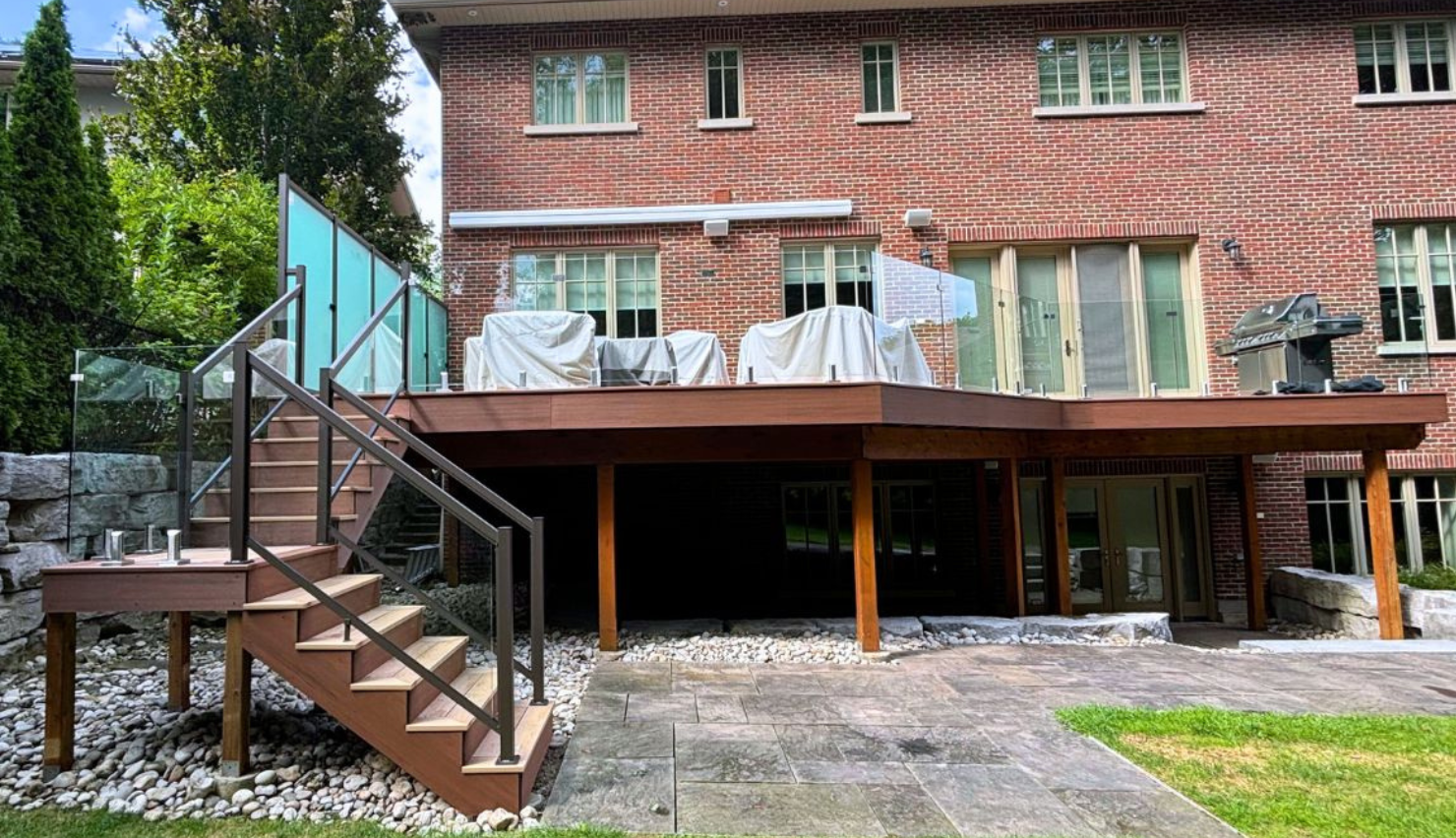
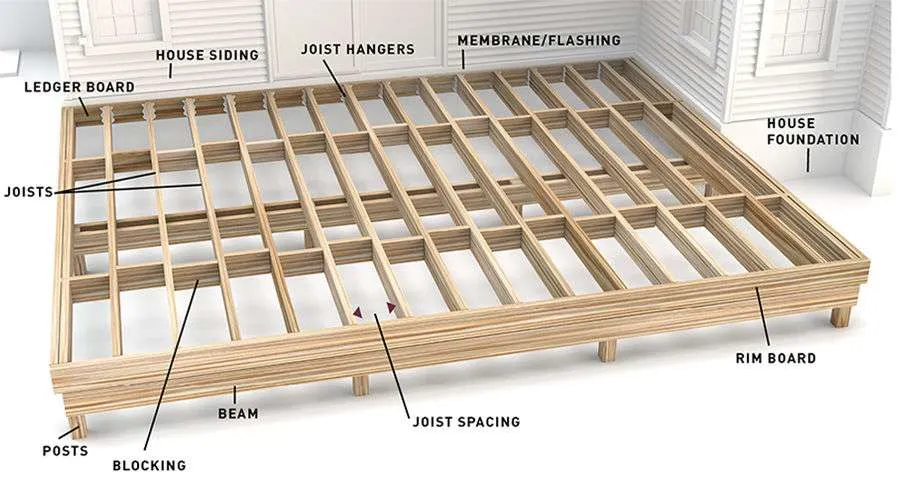
Let’s start from scratch. Blocking is wood inserted between joists on a deck, kind of like putting braces between your teeth. You don’t see it once the deck is done, but it makes everything more solid.
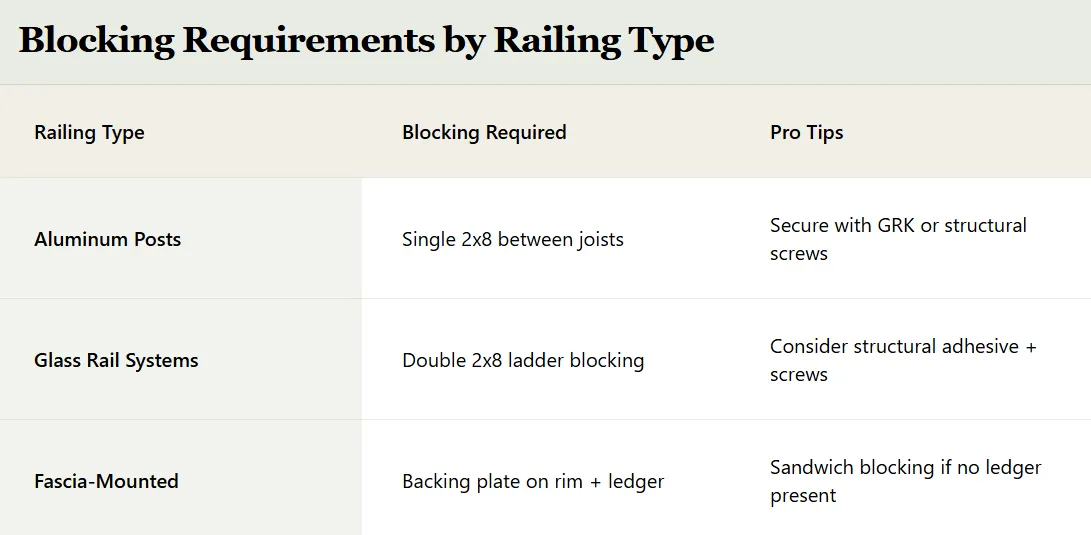
If you’re installing a railing, especially surface-mounted aluminum or glass systems, blocking is the unsung hero. No blocking? Your railing ends up anchored into thin air. Or worse, into soft wood that flexes every time someone leans on it.
Imagine you’re putting up a coat hook in drywall. You don’t just screw into the wall and hope, right? You find a stud — or better yet, add a backing plate.
Blocking is the stud for your railing system. It:
Because code isn’t just a rulebook — it’s a survival guide.
Your deck railing must resist:
That force transfers directly through the post, into the fasteners, and straight to whatever’s below it.
If what’s below is just decking or a joist edge, the railing won’t function at it’s optimal safety requirements.
We once saw a beautiful deck with $20,000 of glass railing. But every time the wind blew or a guest leaned over the edge, the posts wobbled like a folding chair in a thunderstorm.
The problem? No blocking. The builder assumed the joist itself was “good enough.” But pressure-treated lumber has one goal: to rot slowly. It’s not a precision anchor point.
🚫 Mistake 1: Screwing into deck boards
→ Decking is not structural. Your screws will strip out over time.
✅ Solution: Add 2x blocking between joists underneath the decking where the post lands.
🚫 Mistake 2: Blocking too low
→ If the blocking isn’t right under the post base, the leverage works against you.
✅ Solution: Blocking should be flush with the top of the joist — so the post sits directly above the reinforced area.
🚫 Mistake 3: Only one layer of blocking
→ For heavy systems (like glass) or corners, one layer isn’t enough.
✅ Solution: Use cross-blocking or “ladder framing” — two rows of blocking, tied together — to spread force across a wider area.
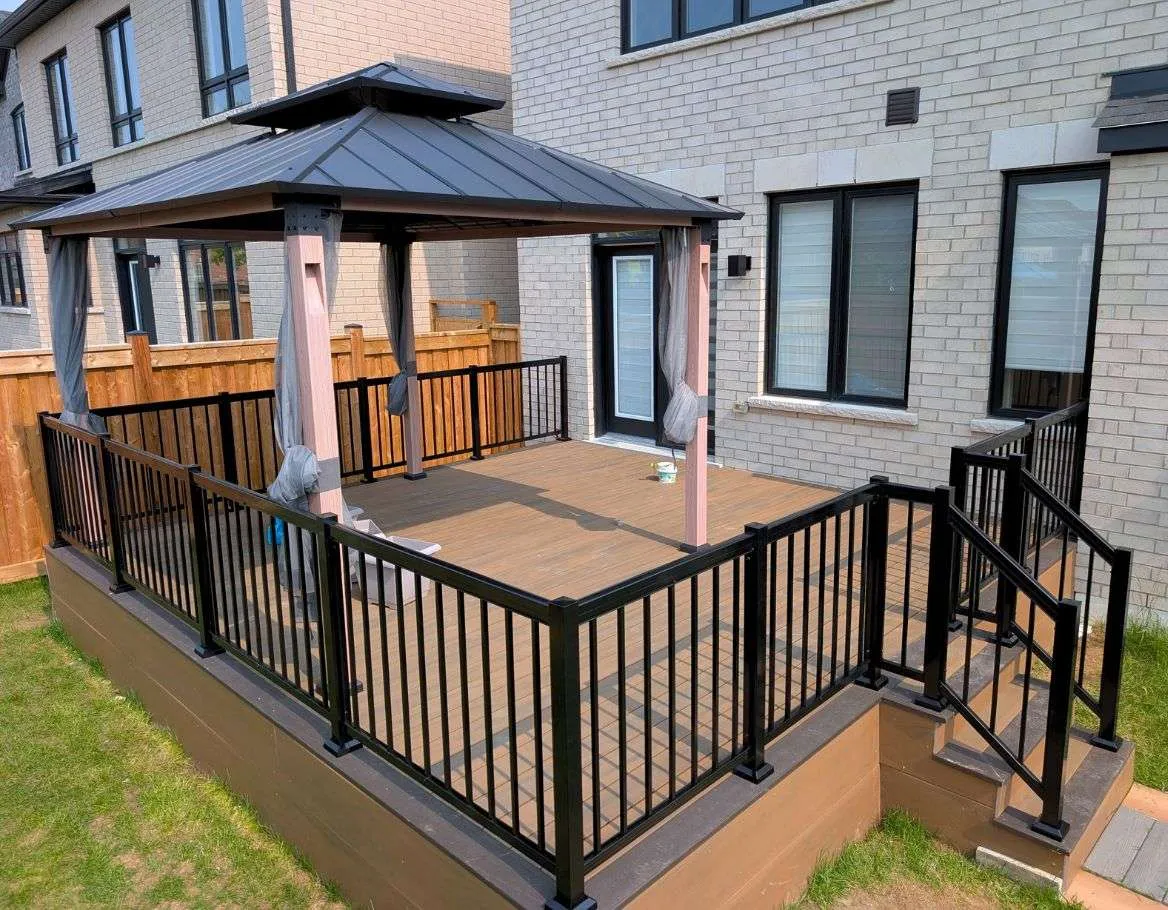
It doesn’t cost much. It doesn’t take long. But blocking is the difference between a railing that lasts 20 years and one that starts rattling by year two.
So here’s the truth: The best railing in the world is only as strong as what it’s screwed into. If you want to build decks that feel like fortresses, not diving boards, start with blocking.
Whatever your project, our team offers expert guidance through every step of the installation process. Our blog articles are taken from real world experiences of our homebuilder clients as we learn what is most important to you. That way, we save you time, money, and prevent headaches, by informing your decision making at every step.
Reach out to Canada Deck and Rail today for a free quote and see how glass railings can increase your property value, improve safety, and give your space the modern look it deserves.